Learn us study properties of proportions,
The four properties that follow are not difficult to justify algebraically, but the details will not be presented here.
Property 1 (Means-Extremes Property, or Cross-Products Property): If a/b = c/d, then ad =bc. Conversely, if ad = bc ≠ 0, then and
and  .
.
Example 1: Find a if a/12 = 3/4.
By Property 1:
Example 2: Is 3 : 4 = 7 : 8 a proportion?
No. If this were a proportion, Property 1 would produce
Property 2 (Means or Extremes Switching Property): If a/ b = c/ d and is a proportion, then both d/ b = c/ a and a/ c = b/ d are proportions.
Example 3: 8/10 = 4/5 is a proportion. Property 2 says that if you were to switch the 8 and 5 or switch the 4 and 10, then the new statement is still a proportion.
If 8/10 = 4/5, then 5/10 = 4/8, or if 8/10 = 4/5, then 8/4 = 10/5.
Hope the above explanation helped you.
The four properties that follow are not difficult to justify algebraically, but the details will not be presented here.
Property 1 (Means-Extremes Property, or Cross-Products Property): If a/b = c/d, then ad =bc. Conversely, if ad = bc ≠ 0, then
and .
|
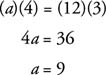
Example 1: Find a if a/12 = 3/4.
By Property 1:
|
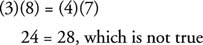
Example 2: Is 3 : 4 = 7 : 8 a proportion?
No. If this were a proportion, Property 1 would produce
|
Property 2 (Means or Extremes Switching Property): If a/ b = c/ d and is a proportion, then both d/ b = c/ a and a/ c = b/ d are proportions.
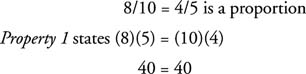
Example 3: 8/10 = 4/5 is a proportion. Property 2 says that if you were to switch the 8 and 5 or switch the 4 and 10, then the new statement is still a proportion.
If 8/10 = 4/5, then 5/10 = 4/8, or if 8/10 = 4/5, then 8/4 = 10/5.
Hope the above explanation helped you.


No comments:
Post a Comment